Rakit
An AI-driven SDLC orchestrator - a seven-stage pipeline with measurable quality gates, not just code generation.
- Role
- Designer & developer
- Year
- 2026
- Status
- In development
The idea
Today’s code generation tools produce something quickly and then stop. The unanswered questions: is it correct, can it be tested, and who is accountable when it is wrong.
Rakit tries to invert the order. Before a single line of code is written, the system must produce artifacts a human can inspect: requirements, a system contract, a task breakdown, and locked acceptance tests. Code is only done when those tests are green.
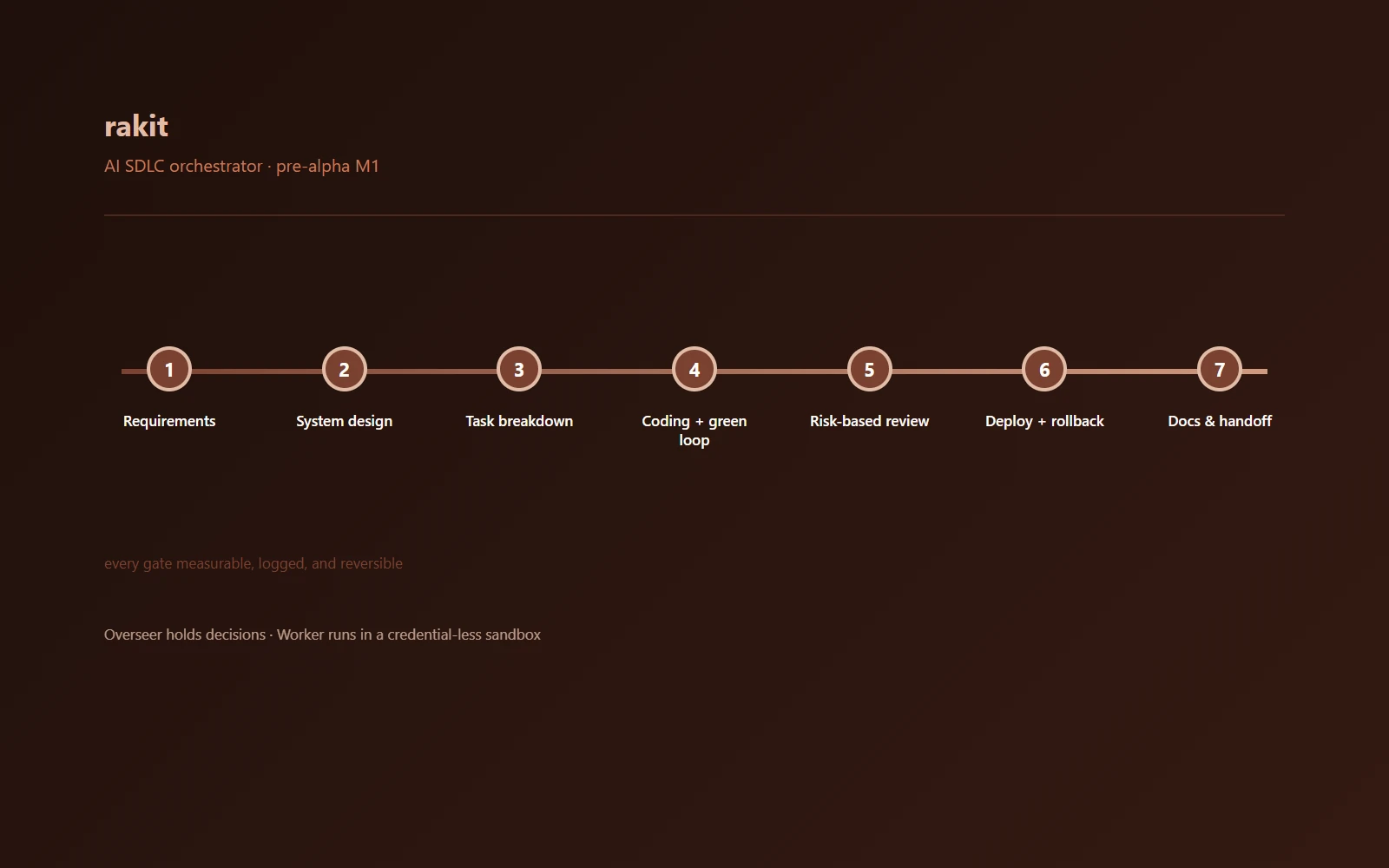
Seven stages
- Requirements —
PRD.json - System design —
CONTRACT.json,ARCHITECTURE.md - Task breakdown + locked acceptance tests
- Coding in a sandbox with a green loop
- Risk-based review — AI reviewer and a human Overseer
- Deploy with automatic rollback
- Documentation and handoff
Every gate is measurable, logged, and reversible. If stage three fails, stage four does not run.
Division of labour
The Overseer holds decisions: accepting contracts, approving risk, signing off deployments. The Worker executes bounded tasks in a credential-less sandbox. The split is deliberate — a language model should never hold production keys.
Status
The project is pre-alpha, milestone M1 (foundation). The CLI is still scaffolding. The repository holds the full plan, architecture decision records, and a per-level definition of done — all open to read and critique.
What exists: monorepo structure, shared Zod schemas, and the sandbox contract. What does not: orchestration, dashboard, and cost evaluation.